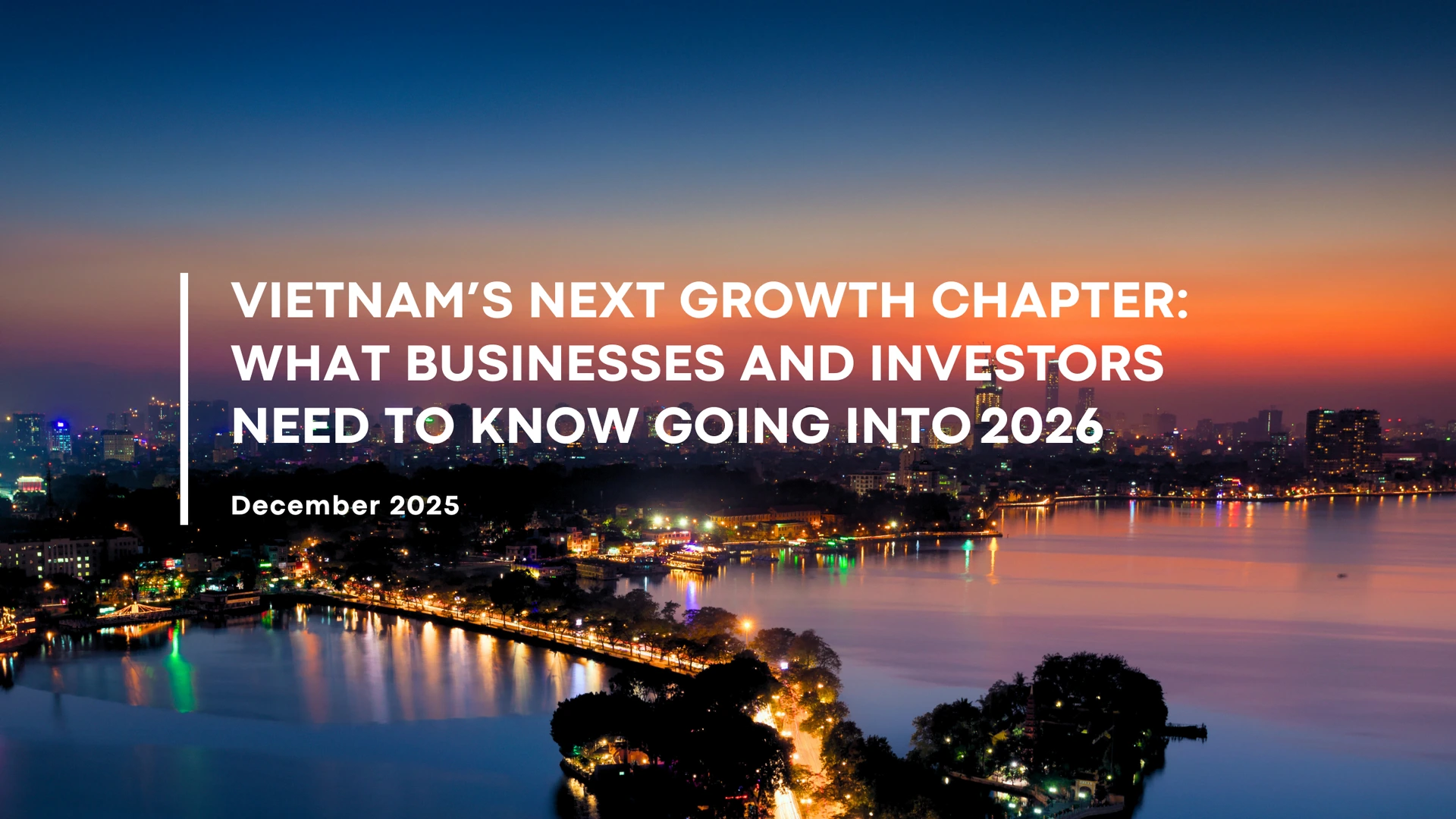
Vietnam’s economic success is no longer the surprise it once was. Over the past decade the country has transformed itself into a magnet for manufacturing and services investment, joining global supply chains and lifting millions out of poverty. Its attractiveness comes not only from favourable demographics and geography but from disciplined macro‑economic management, integration into regional and global trade agreements and a willingness to reform. As 2026 approaches, however, Vietnam’s growth story is becoming more complex. The government is pushing for a transformation built around green and digital growth, and that transformation is being codified through sweeping administrative reforms and an unprecedented volume of new legislation. Businesses and investors therefore need to look beyond headline numbers and understand the legal and institutional foundations that will shape Vietnam’s next chapter.
1. Economic Momentum Meets Policy Reset
At the Annual Vietnam Business Forum (VBF) 2025, Prime Minister Pham Minh Chinh reiterated that Vietnam’s gross domestic product (GDP) is on course to exceed 8 percent in 2025, bringing average growth for the 2021‑2025 period to around 6.3 percent and projecting 10 percent growth in 2026. In the first nine months of 2025 the economy expanded 7.85 percent, registering 15.6 percent growth in foreign investment pledges and 8.8 percent growth in disbursed investment capital. Vietnam’s resilience is reflected in its improving rankings on indices measuring innovation, e‑government performance and happiness. It has signed seventeen free‑trade agreements and has eliminated or simplified 4,300 business regulations, signaling the government’s commitment to a more business‑friendly environment.
Yet the macro story is only part of the picture. 2025 has been characterised by an unprecedented number of policy initiatives. The ruling Communist Party has embraced a strategy of “three together” – listening and understanding together, sharing aspirations together, and winning and developing together – with the business community. This spirit underpins the government’s determination to accelerate administrative reform, decentralise decision‑making and embed sustainability and technology at the core of growth. Investors should expect continued regulatory tightening in some areas, including anti‑money‑laundering and tax compliance, alongside liberalisation in others, such as market access for services and digital‑economy initiatives.
2. Legal Trends in 2025: Restructuring the State and Modernising Corporate Governance
Vietnam’s legal landscape is evolving on multiple fronts. As updated in our article earlier this year, the most significant development in 2025 – with impacts lasting decades to come – is the sweeping government restructure that merged ministries, consolidated local administrative units and streamlined functions. These changes are designed to create a leaner and more service‑oriented bureaucracy, aiming to reduce overlap, clarify lines of authority and improve the efficiency of public administration.
Corporate‑governance reforms have progressed in tandem. Amendments to the enterprise law introduced the concept of the ultimate beneficial owner and tightened capital‑contribution rules, reinforcing transparency and aligning Vietnam with international norms. These changes have been explored in depth in our July 2025 law‑updates article, which explains the disclosure obligations for new and existing companies and the potential compliance implications. We anticipate further guidance on implementation in 2026.
Looking ahead, the National Assembly has approved a plan to establish an international financial centre split between Ho Chi Minh City and Da Nang. The centre will feature liberalised foreign‑exchange controls, targeted tax incentives and a regulatory sandbox for fintech innovation. More detailed regulations are expected next year. For now, investors should recognise that Vietnam is positioning itself as a regional financial hub and should monitor developments in tax, licensing and digital‑finance frameworks.
3. Digital and Green Transformation: From Policy Slogans to Regulatory Frameworks
The government’s priority themes of green and digital transformation remain the central pillars of economic strategy. At the VBF, officials emphasised that green transformation is a necessity and digital transformation the accelerator, urging businesses to invest in clean energy, adopt circular‑economy models and build digital capabilities. The key legal trend is the shift from aspirational slogans to concrete frameworks. Vietnam has adopted national strategies on green growth and the circular economy, is developing standards for ESG reporting and carbon markets and is overhauling its power‑development plan to accelerate renewable‑energy projects. For investors, this means heightened expectations around sustainability disclosure, waste management, energy use and supply‑chain transparency.
Digital‑economy regulation is evolving in parallel. Two separate initiatives are reshaping Vietnam’s digital economy framework. The Law on Digital Technology Industry, passed in June 2025 is Vietnam’s first comprehensive framework for the digital sector, outlining key activities, incentives and infrastructure plans, and will take effect on 1 January 2026. A second measure, the draft Law on Digital Transformation, is still under legislative review and aims to unify rules for digital infrastructure, government, economy and society. Together, these initiatives signal a more strategic approach to data governance, cybersecurity and e-commerce.
Vietnam has also recently moved to formally recognise digital assets as property. This landmark development establishes a legal foundation for ownership, transfer and dispute resolution. We examined the implications for businesses in our August 2025 article on digital assets, noting that a government‑supervised pilot trading system is under consideration. The VBF discussions on digital assets highlighted the need to balance innovation and risk management; more detailed rules are expected in 2026.
VBF Forum discussions showed clear agreement among business groups on Vietnam’s development priorities. Participants urged the government to speed up institutional reforms, strengthen regulatory predictability, and support green growth and digital transformation. They emphasised linking FDI with domestic firms to boost technology transfer, developing a future-ready workforce, and mobilising private capital for sustainable infrastructure and green finance. Across all sectors, business leaders stressed that coordinated, responsive government action is essential to turn reforms into practical support for enterprises and investors.
4. Opportunities and Expectations for 2026
The period leading up to 2026 will likely determine whether Vietnam can transition from a high growth emerging economy to a sustainable, innovation driven powerhouse. The government’s plan to achieve at least 10 percent growth starting in 2026 rests on creating new growth drivers beyond traditional manufacturing and exports. For the private sector, this means aligning business strategies with Vietnam’s development agenda:
- Embrace ESG and circular business models. Companies are expected to reduce emissions, recycle resources and meet stricter environmental and social standards. Firms that invest early in sustainability will be better positioned to meet future compliance requirements and participate in global supply chains.
- Invest in technology and human capital. The digital era requires investments in automation, AI, cloud computing and cybersecurity, coupled with programmes to train and retain digital talent. Partnerships with universities and vocational schools can help address skill shortages.
- Participate in energy transition projects. Implementation of Power Development Plan VIII and related policies will open opportunities in offshore wind, LNG, solar and battery storage. Removing bankability obstacles will require creative financing and collaboration with local banks and multilateral lenders.
- Support policy dialogue and administrative reform. Investors should engage with government through chambers and associations to provide feedback on tax, customs, land and permit procedures. Transparent dialogue has already helped eliminate thousands of regulations and will continue to shape the investment environment.
- Build partnerships across the FDI–domestic divide. VBF leaders described foreign and domestic enterprises as “dual drivers” of growth. Foreign groups bring capital, advanced technology and global standards, while Vietnamese firms provide local knowledge, supply chain connectivity and the ability to diffuse sustainability practices. Joint ventures, supplier development programmes and R&D collaboration can maximise these complementarities.
- Plan for climate resilience. Natural disasters are becoming more frequent and unpredictable. Companies should incorporate climate risk assessments into supply chain planning and invest in resilient infrastructure and insurance.
5. Conclusion: Law and Policy as Growth Drivers
Vietnam’s next growth chapter will be shaped not only by market forces but by the legal and institutional frameworks that the government is constructing. 2025 has been a watershed year, with ambitious plans to restructure the state, modernise corporate governance, recognise digital assets and prepare comprehensive digital and green‑economy legislation. These developments complement Vietnam’s strong economic momentum and signal a commitment to building an innovation‑driven, sustainable and internationally integrated economy. To thrive in this environment, investors must align business strategies with emerging legal trends, engage in policy dialogue and invest in compliance and human capital. Those who do will be well placed to ride the next wave of Vietnam’s growth.
© PDLegal LLC
This article is intended to provide general information only and does not constitute legal advice. It should not be used as a substitute for professional legal consultation. We recommend seeking legal advice before making any decisions based on the information available in this article. PDLegal fully disclaims responsibility for any loss or damage which may result from relying on this article.
Further information
Should you want to stay updated on the regulatory changes in Vietnam and how these developments may affect you or your business, please get in touch with the following persons: