
Skip to content
  • About
  • Accolades
  • Practices
    • China Desk
    • Corporate M&A
    • Corporate, Commercial & Civil Litigation
    • Cryptocurrency Disputes
    • Employment & Industrial Relations
    • Financial Services
    • India Desk
    • International Arbitration
    • Maritime & Shipping
    • Private Client Disputes & Advisory
    • Real Estate & Construction
    • Restructuring & Insolvency
    • Tax
    • Vietnam Desk
    • White Collar Crime & Criminal
    View all
    China Desk
    Corporate M&A
    Corporate, Commercial & Civil Litigation
    Cryptocurrency Disputes
    Employment & Industrial Relations
    Financial Services
    India Desk
    International Arbitration
    Maritime & Shipping
    Private Client Disputes & Advisory
    Real Estate & Construction
    Restructuring & Insolvency
    Tax
    Vietnam Desk
    White Collar Crime & Criminal
  • People
  • Insights
  • Countries
    Offices
    • Singapore
    • Thailand
    • Malaysia
    • Australia
    Regional Desks
    • China
    • India
    • Vietnam
Enquiries
Strengthening Corporate Governance Through Effective Compliance Policies in Singapore
  • Blog
  • | 14 October 2026

Strengthening Corporate Governance Through Effective Compliance Policies in Singapore

Corporate governance in Singapore runs on a mix of statutory duty and self-discipline, and the companies that stay out of trouble treat their compliance calendar the way they treat payroll, as something that happens on schedule whether or not anyone feels like doing it. Every private company incorporated here needs a qualified company secretary within six months of incorporation under the Companies Act, and ACRA has been steadily raising the cost of getting this wrong through late filing penalties and, in repeat cases, director disqualification.
PD Legal has handled corporate secretarial work for Singapore-based companies long enough to see the same governance gaps repeat across industries, usually at firms that treated compliance as an annual scramble rather than a running function.

What Does Corporate Governance Actually Mean for a Singapore Company

Corporate governance is the structure of rules, roles, and reporting lines that decides who is accountable when something goes wrong inside a company, not a set of aspirational values printed in an annual report. In Singapore it sits on three legs: the Companies Act, which sets hard statutory duties; the Code of Corporate Governance, which applies to listed entities but shapes best practice for private ones too; and internal policies a company writes for itself, covering things like conflicts of interest and related party transactions. A private limited company with five directors and no governance policy at all is still legally compliant on paper, right up until a dispute forces someone to ask who approved what and when. The gap between legally compliant and actually governed well is exactly where most disputes start.

Why Do Compliance Policies Matter More Than They Used To

Singapore’s regulatory environment has gotten less forgiving over the past few years, not more. ACRA’s enforcement has shifted from warning letters to actual composition fines for late annual return filings, and the Monetary Authority of Singapore has pushed banks to demand tighter beneficial ownership disclosure before opening or maintaining corporate accounts. A few specific pressures worth naming:
  • Annual return filing deadlines are tied to the AGM date, and missing them triggers escalating fines rather than a single flat penalty
  • Register of Registrable Controllers requirements mean companies now need to actively track and update beneficial ownership, not just file it once at incorporation
  • Banks increasingly ask for updated corporate secretarial records before processing account changes, which stalls business when the paperwork lags
  • Cross-border shareholders and directors add a layer of KYC documentation that most local-only companies never had to deal with before
None of this is dramatic on its own, but stacked together it means a company running on outdated compliance habits from five years ago is quietly accumulating risk it doesn’t see until a bank or regulator asks a question.

What Is the Difference Between a Company Secretary and Corporate Secretarial Services

A company secretary is the named, qualified individual (or corporate entity) legally required to hold the role under Singapore law. Corporate secretarial services is the broader function around that role, statutory filings, board minute preparation, share register maintenance, and compliance monitoring, which is often outsourced to a firm rather than handled by a single named person in-house. Smaller and mid-sized companies almost always outsource this because hiring a full-time qualified secretary for administrative work that takes a few hours a month rarely makes financial sense. Larger companies sometimes keep the role in-house but still lean on external corporate secretarial support for anything specialised, like a share restructuring or a cross-border compliance question.

Who Is Legally Required to Have a Company Secretary in Singapore

Every private company incorporated in Singapore must appoint a company secretary within six months of incorporation, per Section 171 of the Companies Act. Sole directors cannot double as the company secretary in a single-director company. The secretary must be a natural person ordinarily resident in Singapore, and for public companies the qualification requirements are stricter, generally requiring membership in a recognized professional body such as the Institute of Singapore Chartered Secretaries.

How Much Do Corporate Secretarial Services Cost in Singapore

Pricing depends heavily on company complexity, but most Singapore secretarial firms structure it as an annual retainer rather than hourly billing.
  • Basic packages for a simple private limited company with one or two directors typically start around S$500 to S$800 a year, covering statutory filings and minute keeping
  • Mid-tier packages with more active board activity, share transfers, or multiple subsidiaries usually run S$1,000 to S$2,500 a year
  • Companies with foreign shareholders, complex share structures, or frequent board resolutions can push past S$3,000 a year once ad hoc work gets added in
  • One-off services like striking off a dormant company or handling a share allotment are usually billed separately from the retainer
Firms that quote a flat low fee with no mention of what falls outside the retainer are usually the ones that surprise clients with add-on invoices later, so it’s worth asking upfront what triggers extra billing.

What Happens if a Singapore Company Doesn’t Comply With Governance Requirements

Non-compliance escalates in stages rather than hitting all at once. A late annual return filing starts with a composition fine from ACRA, typically a few hundred dollars, but repeated lapses can lead to the company being struck off the register entirely. Directors found in breach of their statutory duties under the Companies Act can face personal fines or, in serious cases involving fraud or gross negligence, disqualification from holding any directorship in Singapore for up to five years. The Singapore Institute of Directors publishes governance guidance that a lot of boards reference specifically because it spells out where personal director liability starts, which is often earlier than directors expect.

What Do Independent Sources Say About Governance Standards in Singapore

Singapore consistently ranks near the top of global governance and business environment indices, which is part of why multinational companies keep choosing it as a regional base despite the compliance overhead. The World Bank’s Ease of Doing Business data has historically placed Singapore among the highest-ranked jurisdictions for regulatory quality, and ACRA itself publishes enforcement statistics that show fine volumes rising year over year, a sign the regulator is actually acting on the rules rather than letting them sit unenforced. For companies comparing corporate service providers locally, directories such as thebestinsg.com track supplier reputations across professional services, and business content creators connected through platforms like GetMyInfluencer have increasingly covered Singapore’s compliance environment as more founders search for practical guidance rather than legal jargon. Regional comparisons across cities are also tracked through directories like TheBestIn.World, useful context for companies weighing Singapore against other regional hubs.

Why Work with PD Legal

PD Legal handles corporate secretarial work for a range of Singapore-incorporated companies, from single-director startups to firms with multiple subsidiaries and foreign shareholders. The value isn’t just filing paperwork on time, it’s catching the small governance gaps before they turn into a bank query or an ACRA fine, things like an outdated register of controllers or a board resolution that never got properly minute. Companies that switch to PD Legal after years of ad hoc compliance usually find the same pattern: the paperwork was technically done, just not done in a way that would hold up if someone asked hard questions about it. That gap between filed and defensible is where a proper corporate secretarial function earns its cost.

Conclusion

Good governance in Singapore isn’t about ticking regulatory boxes once a year, it’s a running function that either gets built properly or quietly accumulates risk until something forces the issue. Companies that treat their company secretary as an administrative afterthought tend to find out the hard way, usually at the worst possible moment, whether that’s a bank freezing an account update or a director facing personal liability for something the board never formally approved. If governance and compliance have been running on a patchwork of reminders and last-minute filings, it’s worth getting a proper review done before ACRA or a bank does it for you. Get in touch with PD Legal to talk through what a company’s current secretarial setup is covering, and what it isn’t!
TA - Vertex Ventures
  • News
  • | 16 November 2026

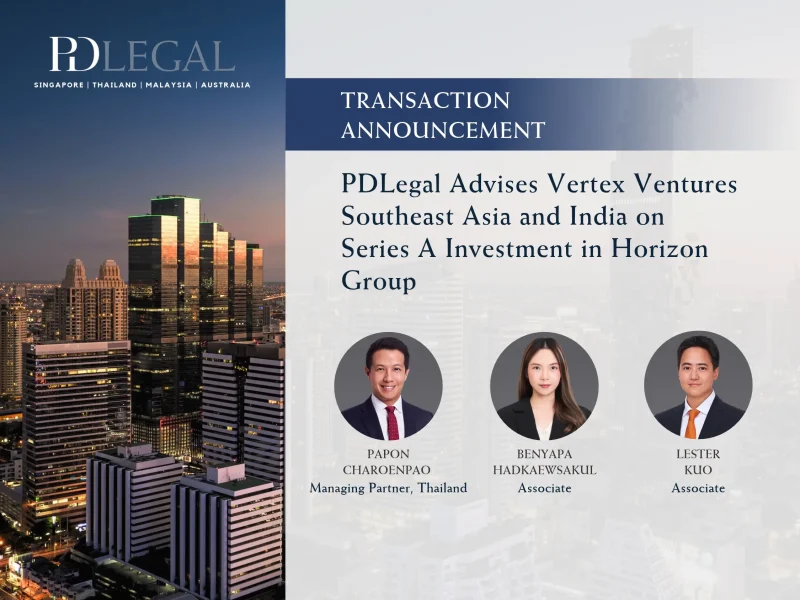
PDLegal Advises Vertex Ventures Southeast Asia and India on Series A Investment in Horizon Group

PDLegal is pleased to have acted as Thai and Singapore legal counsel to Vertex Ventures Southeast Asia & India (Vertex), (...)

More Insights
Find Us
  • Singapore

PDLegal LLC Singapore
1 Coleman Street 

#08-02 The Adelphi 

Singapore 179803

Tel: +65 6220 0325
Email: [email protected]

  • Thailand

PDLegal Asia (Thailand) Co., Ltd.
6th Floor, 6 O-NES Tower,
Sukhumvit Soi 6,
Khlong Toey, Bangkok 10110

Tel: +66 2 254 6415
Email: [email protected]

  • Malaysia

Tan, Siew & Lee (TSL Legal)
9-1, Level 9,
Wisma UOA Damansara II,
No. 6, Jalan Changkat Semantan,
Damansara Heights,
50490 Kuala Lumpur

Tel: +603 3009 7825
Email: [email protected]

  • Australia
PDLegal Australia
Level 3, Suite 12
58 Pitt Street
Sydney NSW 2000

Tel: +61 2 7813 7619
Email: [email protected]

Offices
  • Singapore
  • Thailand
  • Malaysia
  • Australia
Regional Desks
  • China
  • India
  • Vietnam
Follow Us
PDLegal LLC is a limited liability company registered in Singapore. The Firm is regulated by the Legal Services Regulatory Authority of Singapore. © All rights reserved 2026.
  • Privacy policy
  • Legal Notice
  • Cookie Policy
Cookies on our website

We use cookies on our site to remember you, show you content we think you will like and help you to use this site. For more details, please see our cookies policy.

Click ‘Accept’ to consent to cookies other than strictly necessary cookies or ‘Reject’ if you do not. You can change your mind at any time by visiting our cookie policy page.

Functional Always active
The technical storage or access is strictly necessary for the legitimate purpose of enabling the use of a specific service explicitly requested by the subscriber or user, or for the sole purpose of carrying out the transmission of a communication over an electronic communications network.
Preferences
The technical storage or access is necessary for the legitimate purpose of storing preferences that are not requested by the subscriber or user.
Statistics
The technical storage or access that is used exclusively for statistical purposes. The technical storage or access that is used exclusively for anonymous statistical purposes. Without a subpoena, voluntary compliance on the part of your Internet Service Provider, or additional records from a third party, information stored or retrieved for this purpose alone cannot usually be used to identify you.
Marketing
The technical storage or access is required to create user profiles to send advertising, or to track the user on a website or across several websites for similar marketing purposes.
  • Manage options
  • Manage services
  • Manage {vendor_count} vendors
  • Read more about these purposes
View preferences
  • {title}
  • {title}
  • {title}
  • About
  • Accolades
  • Practices
    • China Desk
    • Corporate M&A
    • Corporate, Commercial & Civil Litigation
    • Cryptocurrency Disputes
    • Employment & Industrial Relations
    • Financial Services
    • India Desk
    • International Arbitration
    • Maritime & Shipping
    • Private Client Disputes & Advisory
    • Real Estate & Construction
    • Restructuring & Insolvency
    • Tax
    • Vietnam Desk
    • White Collar Crime & Criminal
    View all
  • People
  • Careers
  • Insights
  • Countries
    Offices
    • Singapore
    • Thailand
    • Malaysia
    • Australia
    Regional Desks
    • China
    • India
    • Vietnam
Enquiries